
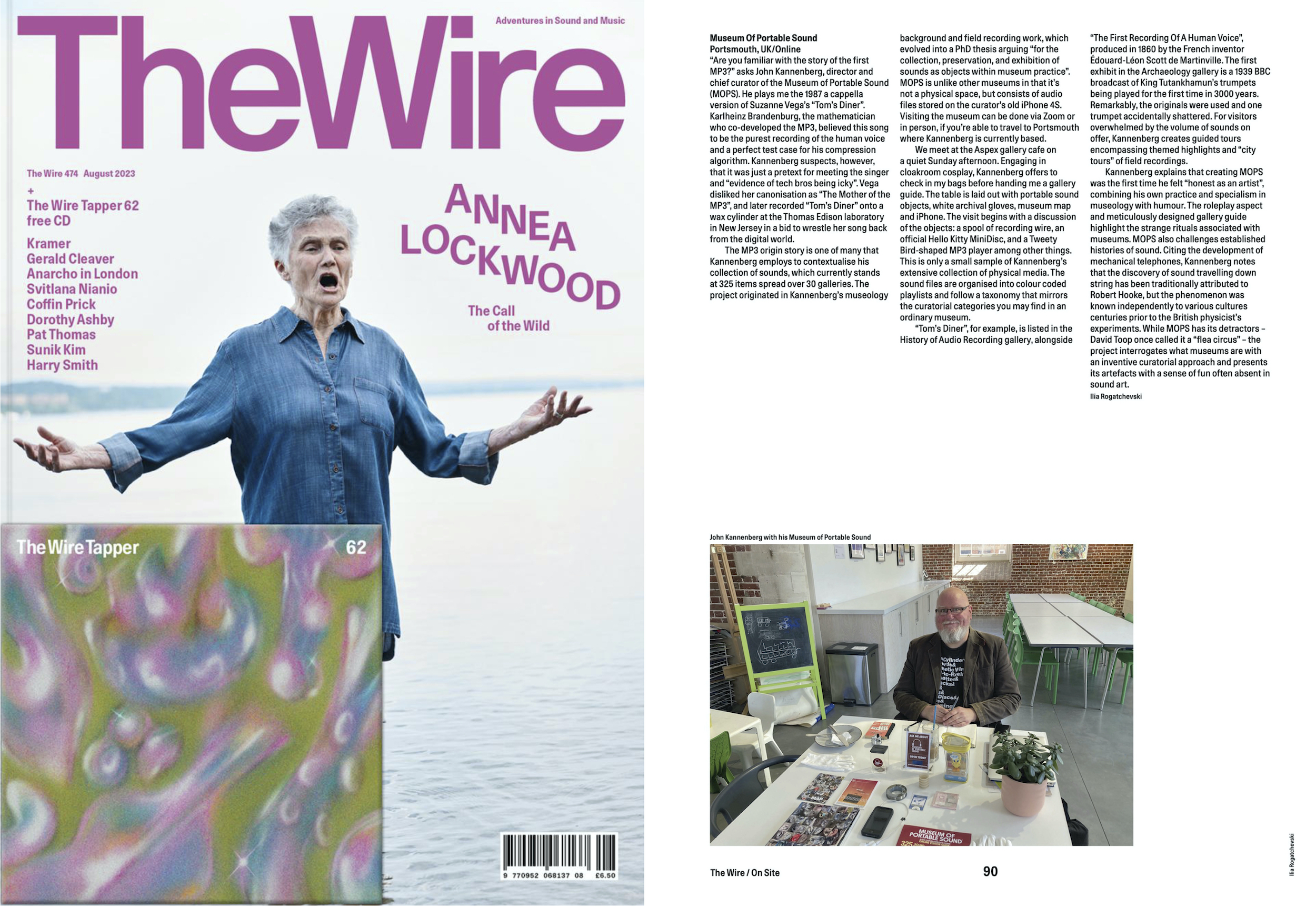
The current issue of the London experimental music magazine The Wire (issue 474, August 2023) contains a full-page review of our museum written by Ilia Rogatchevski, who visited our museum both online and in-person in order to research the piece. The text reads:
“Are you familiar with the story of the First MP3?” asks John Kannenberg, director and chief curator of the Museum of Portable Sound (MOPS). He plays me the 1987 a cappella version of Suzanne Vegas “Tom’s Diner.” Karlheinz Brandenburg. the mathematician who co-developed the MP3, believed this song to be the purest recording of the human voice and a perfect test case for his compression algorithm. Kannenberg suspects, however, that it was just a pretext for meeting the singer and “evidence of tech bros being Icky”. Vega disliked her canonisation as “The Mother of the MP3” and later recorded “Tom’s Diner” onto a wax cylinder at the Thomas Edison laboratory in New Jersey in a bid to wrestle her song back from the digital world.
The MP3 origin story is one of many that Kannenberg employs to contextualise his collection of sounds. which currently stands at 325 items spread over 30 galleries. The project originated in Kannenberg’s museology background and field recording work, which evolved into a PhD thesis arguing for “the collection, preservation, and exhibition of sounds as objects within museum practice”.
MOPS is unlike other museums in that it’s not a physical space, but consists of audio files stored on the curator’s old iPhone 4S. Visiting the museum can be done via Zoom or in person, if you’re able to travel to Portsmouth where Kannenberg is currently based.
“MOPS interrogates what museums are with an inventive curatorial approach and presents its artefacts with a sense of fun often absent in sound art.”
We meet at Aspex gallery café on a quiet Sunday afternoon. Engaging in cloakroom cosplay, Kannenberg offers to check in my bags before handing me a gallery guIde. The table Is laid out with portable sound objects, white archival gloves, museum map and iPhone. The visit begins with a discussion of the objects: a spool of recording wire, an official Hello Kitty MiniDisc, and a Tweety Bird-shaped MP3 plaver among other things. This is only a small sample of Kannenberg’s extensive collection of physical media. The sound files are organised into colour-coded playlists and follow a taxonomy that mirrors the curatorial categories you may find in an ordinary museum.
“Tom’s Diner” for example, is listed in the History of Audio Recording gallery, alongside “The First Recording Of A Human Voice” produced in 1860 by French inventor Édouard-Léon Scott de Martineville. The first exhibit in the Archaeology gallery is a 1939 BBC broadcast of kind Tutankhamun’s trumpets being played for the first time in 3000 years. Remarkably, the originals were used and one trumpet accidentally shattered. For visitors overwhelmed by the volume of sounds on offer, Kannenberg creates guided tours encompassing themed highlights and “city tours” of field recordings.
Kannenberg explains that creating MOPS was the first time he felt “honest as an artist”, combining his own practice and specialism in museology with humour. The roleplay aspect and meticulously designed gallery guide highlight the strange rituals associated with museums. MOPS also challenges established histories of sound. Citing the development of mechanical telephones, Kannenberg notes that the discovery of sound travelling down string has been traditionally attributed to Robert Hooke, but the phenomenon was known independently to various cultures centuries prior to the British physicist’s experiments. While MOPS has its detractors – David Toop once called it a “flea circus” – the project interrogates what museums are with an inventive curatorial approach and presents its artefacts with a sense of fun often absent in sound art.
Ilia Rogatchevski

The Wire issue 474 is on sale now in newsstands and on their website.
 The Museum of Portable Sound