
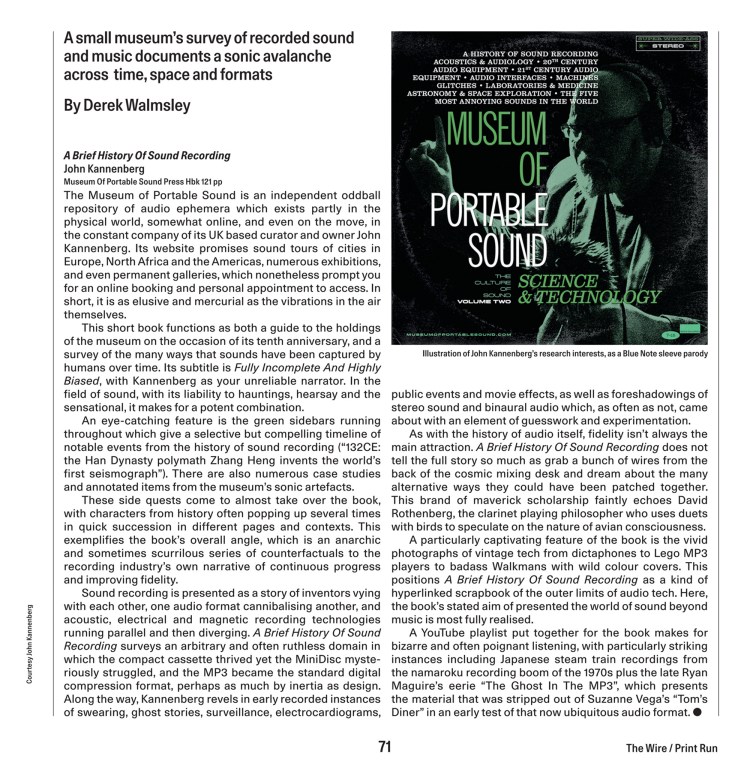
The latest issue of The Wire magazine (no. 505, March 2026) features a 3/4 page review of our new book A Brief History of Sound Recording.
Written by staff writer Derek Walmsley, the review is transcribed below:
A small museum’s survey of recorded sound and music documents a sonic avalanche across time, space and formats
By Derek Walmsley
A Brief History Of Sound Recording
John Kannenberg
Museum Of Portable Sound Press Hbk[sic] 121 pp
The Museum of Portable Sound is an independent oddball repository of audio ephemera which exists partly in the physical world, somewhat online, and even on the move, in the constant company of its UK based curator and owner John Kannenberg. Its website promises sound tours of cities in Europe, North Africa and the Americas, numerous exhibitions, and even permanent galleries, which nonetheless prompt you for an online booking and personal appointment to access. In short, it is as elusive and mercurial as the vibrations in the air themselves.
This short book functions as both a guide to the holdings of the museum on the occasion of its tenth anniversary, and a survey of the many ways that sounds have been captured by humans over time. Its subtitle is Fully Incomplete And Highly Biased, with Kannenberg as your unreliable narrator. In the field of sound, with its liability to hauntings, hearsay and the sensational, it makes for a potent combination.
An eye-catching feature is the green sidebars running throughout which give a selective but compelling timeline of notable events from the history of sound recording (“132CE: the Han Dynasty polymath Zhang Heng invents the world’s first seismograph”). There are also numerous case studies and annotated items from the museum’s sonic artefacts.
…the book’s overall angle…is an anarchic and sometimes scurrilous series of counterfactuals to the recording industry’s own narrative of continuous progress and improving fidelity.
These side quests come to almost take over the book, with characters from history often popping up several times in quick succession in different pages and contexts. This exemplifies the book’s overall angle, which is an anarchic and sometimes scurrilous series of counterfactuals to the recording industry’s own narrative of continuous progress and improving fidelity.
Sound recording is presented as a story of inventors vying with each other, one audio format cannibalising another, and acoustic, electrical and magnetic recording technologies running parallel and then diverging. A Brief History Of Sound Recording surveys an arbitrary and often ruthless domain in which the compact cassette thrived yet the MiniDisc mysteriously struggled, and the MP3 became the standard digital compression format, perhaps as much by inertia as design.
Along the way, Kannenberg revels in early recorded instances of swearing, ghost stories, surveillance, electrocardiograms, public events and movie effects, as well as foreshadowings of stereo sound and binaural audio which, as often as not, came about with an element of guesswork and experimentation.
[The book] does not tell the full story so much as grab a bunch of wires from the back of the cosmic mixing desk and dream about the many alternative ways they could have been patched together.
As with the history of audio itself, fidelity isn’t always the main attraction. A Brief History Of Sound Recording does not tell the full story so much as grab a bunch of wires from the back of the cosmic mixing desk and dream about the many alternative ways they could have been patched together. This brand of maverick scholarship faintly echoes David Rothenberg, the clarinet playing philosopher who uses duets with birds to speculate on the nature of avian consciousness.
A particularly captivating feature of the book is the vivid photographs of vintage tech from dictaphones to Lego MP3 players to badass Walkmans with wild colour covers. This positions A Brief History Of Sound Recording as a kind of hyperlinked scrapbook of the outer limits of audio tech. Here, the book’s stated aim of present[ing] the world of sound beyond music is most fully realised.
A YouTube playlist put together for the book makes for bizarre and often poignant listening, with particularly striking instances including Japanese steam train recordings from the Namaroku recording boom of the 1970s plus the late Ryan Maguire’s eerie “The Ghost In The MP3”, which presents the material that was stripped out of Suzanne Vega’s “Tom’s Diner” in an early test of that now ubiquitous audio format. •
The Wire issue 505 is on sale at newsstands and their website now.
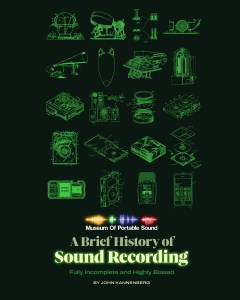
A Brief History of Sound Recording is available now exclusively on our website!
 The Museum of Portable Sound